Impulse & Momentum
About this simulation
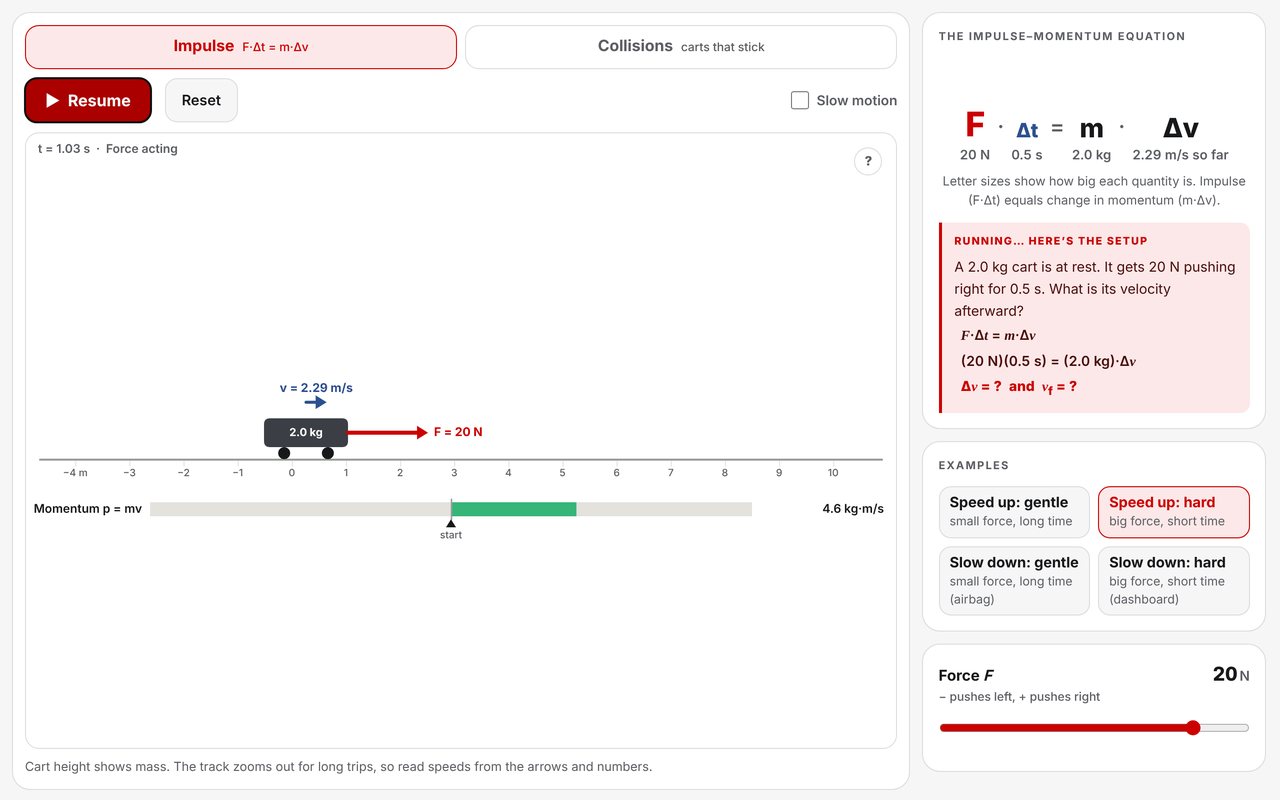
Two tabs. In Impulse, a force pushes a cart for a set time. The equation F·Δt = m·Δv is drawn with each letter sized by its value, so a big force for a short time visibly balances a small force for a long time. The examples come in pairs with the same impulse: two ways to speed up, and two ways to stop — an airbag and a dashboard.
In Collisions, two carts roll toward each other, hit and stick. Bars show each cart’s momentum and the total. The total bar never moves during the crash. The right cart can have a negative velocity, meaning it moves left.
Each tab shows the equation set up with numbers before the run, ending in a question mark, and a worked solution after. Right is positive. There is no friction or air drag, pushes switch on and off as a constant force, and collisions happen instantly.
Learning Goals
- Define impulse as force × time and momentum as mass × velocity
- Use F·Δt = m·Δv to explain why a longer stopping time means a smaller force (airbags, padding)
- Use signs for direction: a negative velocity or force points left
- State that total momentum is the same before and after a collision
- Calculate the final velocity of two carts that stick together
How to Use
- Start on the Impulse tab and run “Speed up: gentle” then “Speed up: hard” — compare the final speeds
- Run the two “Slow down” examples and decide which is the airbag
- Read the equation before pressing Start, predict the answer, then check the solution
- In Collisions, set the masses and velocities, predict the final velocity, then press Start
- Try a heavy slow cart against a light fast one — can you make the stuck carts stop dead?
- Switch to Full for the force–time graph (shaded area = impulse) and the kinetic energy lost in the crash
Classroom Notes
Use after Newton’s Third Law. The paired examples have equal impulses (both speed-ups give Δv = +5 m/s; both slow-downs stop a 6 m/s cart), which makes a good prediction exercise. Labels say “velocity” rather than “speed” because speed can’t be negative. Simple detail is the default; Full adds the graph and energy.