Charge vs. Voltage
About this simulation
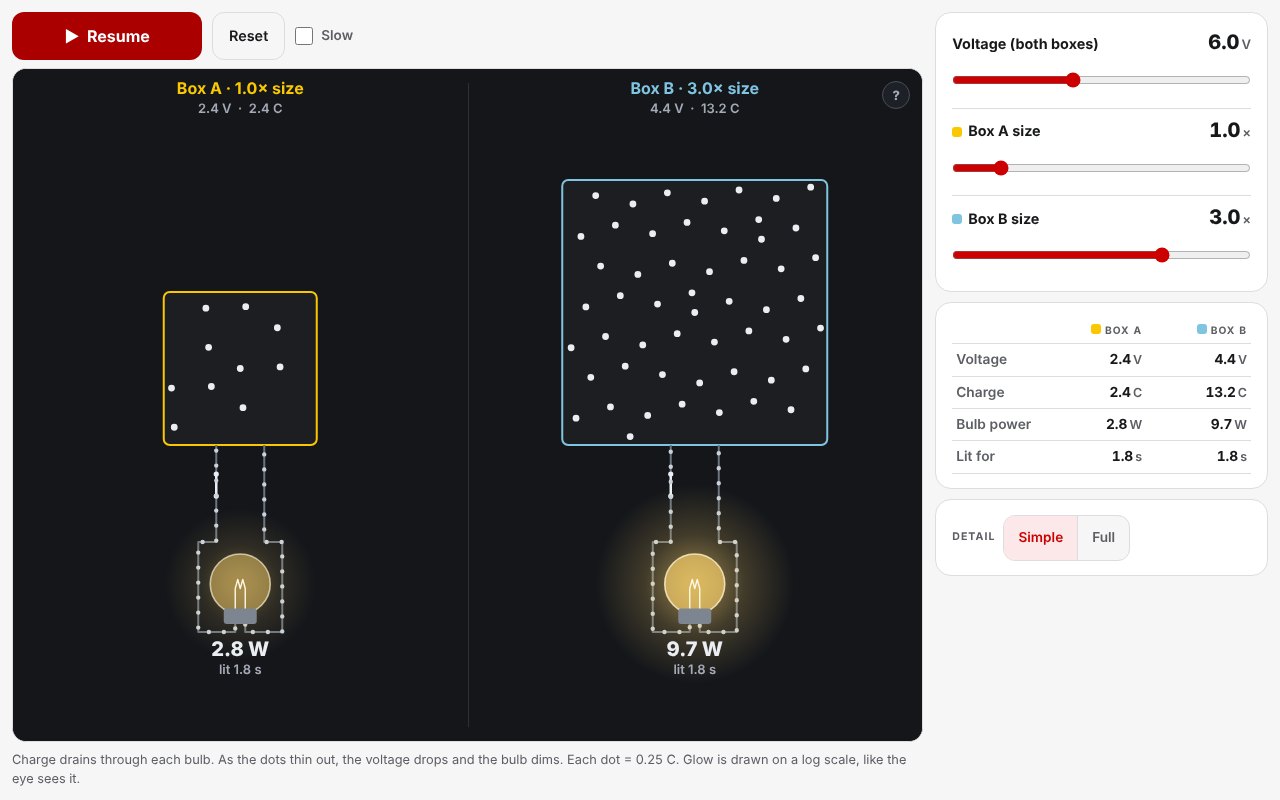
Two boxes store electric charge, and each one is wired through a switch to an identical light bulb. Every dot is a bit of charge. Both boxes are charged to the same voltage, so the dots are equally crowded in both. The bigger box simply has more of them: same voltage, more charge.
Close the switches and both bulbs light at the same power, because power depends on voltage. Then the charge drains away. As the dots thin out the voltage drops and each bulb dims. The bulb on the smaller box goes dark first. At the same voltage, a box three times as big keeps its bulb lit three times as long. More charge, more work done.
Each box is modelled as a pair of plates with the same gap, discharging through a bulb treated as a fixed resistance. Full mode adds stored energy, the equations Q = CV and E = ½QV, and a graph of each bulb’s power over time.
Learning Goals
- Tell voltage and charge apart: voltage is how crowded the charge is, charge is how much there is
- Recognise that the same voltage gives the same starting brightness, whatever the box size
- Explain why more charge at the same voltage can do more work
- Describe why a bulb dims as charge drains: the voltage falls with the charge
- Predict how long a bulb stays lit when the box size or voltage changes
How to Use
- Set the voltage. Compare how crowded the dots are, then compare how many there are
- Press Light the bulbs. The clock holds at switch-on for two seconds so the class can compare the bulbs; the watts match
- Watch the dots move through the wires and thin out in the boxes as the bulbs dim
- Read the timers when each bulb goes dark
- Make both boxes the same size: the bulbs behave identically
- Raise the voltage: both bulbs start brighter, and the dots crowd in both boxes
- Switch to Full for stored energy and the power-versus-time graph
Classroom Notes
The simulation opens at 6 V with a 1× and a 3× box. Box A’s bulb goes dark at 3.6 s and Box B’s at 10.8 s, a clean factor of three that students can read off the timers.
A real discharging bulb starts dimming the instant the switch closes, so without help the small bulb can look dimmer from the start. The sim holds the clock at switch-on for two seconds and says so on screen, so the class sees two equally bright bulbs at the same instant. The watt readouts back that up with a number.
When Box B’s bulb goes dark, its box still holds charge at a low voltage. That is a good question to put to the class: is the box empty? Each dot stands for 0.25 C, and bulb glow is drawn on a log scale, roughly how the eye judges brightness. The sim leaves out sparks on purpose: how far a spark jumps depends on voltage, not charge, so both boxes would spark alike.